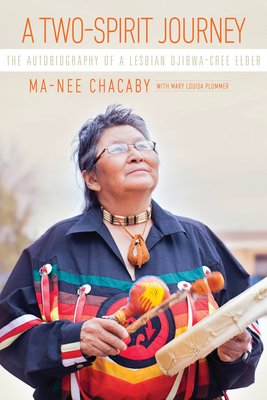
Welcome back to Lesbian Trash Panda, a blog where I, a gay gremlin, review lesbian or otherwise queer media that I love. Today’s installment: “A Two-Spirit Journey.”
ALL ABOUT THAT TRASH HEARTBREAKING STORY
Summary
“A Two-Spirit Journey: The Autobiography of a Lesbian Ojibwa-Cree Elder” is the story of Ma-Nee Chacaby, a Two-Spirit Ojibwa-Cree lesbian who grew up in rural Canada in the 1960s. While her life was extremely difficult and complex, she remains hopeful as she fights for Anishinaabe and Two Spirit rights.
(For readers unfamiliar with these terms, Anishinaabe means “original people” in the Algonquian languages, and it is what Chacaby uses to describe Indigenous people both in her region and generally. The term “Two Spirit” will be the subject of the Queer Context Corner for this post.)
TRIGGERS: This story is a real one and has a LOT of trauma triggers. I have kept my post as neutral and non-triggering as I could, but before reading, see the “”Trigger Warnings”Heads Up Cheat Sheet” section at the bottom of this post for more info.
Why You Should Read This (No Spoilers)
This is a unique book. To my knowledge, there are no other written narratives by lesbian Two-Spirit elders who grew up in the 1960s that are this in-depth.
It’s not just that this is a rare document – the story is so interesting, albeit immensely sad. Ma-Nee Chacaby recounts a difficult childhood, suffering abuse, losing her age-peers to residential schools, and watching her community go through epidemic levels of substance abuse. She recalls a horrible arranged marriage, moving to the city with two kids and no money, and being attacked for being a woman, being a lesbian, and being Indigenous. She struggles with alcoholism, falls ill with tuberculosis, and loses her vision. But she also shares stories about kindness, connection, sobriety, realization, love, and acceptance. Eventually, she becomes a leader and mentor for other Anishinaabe and Two Spirit people.
Hers is a story and perspective that deserves to be heard.
Why I Love This (Yes Spoilers)
I loved learning about Chaceby’s upbringing and getting insight into her Ojibwa-Cree heritage. She details the lifestyle she grew up in, both the good – the connection to nature, family, and community – and the bad – poverty, violence, and alcoholism. She learns about her Ojibwa history from her grandmother, a kind, wise woman written in vivid detail. Her grandmother is the first person who explains to Ma-Nee what it means to be Two Spirit, something Ma-Nee relearns and redefines through her life.
The book provides a hard look at the results of systemic racism on Indigenous peoples in Canada. Virtually no aspect of Chacaby’s life is untouched by this – from developments encroaching on hunting lands, to friends taken to residential schools, to child services removing her own children from her care. At the same time, some issues are more complex – the land developments give her a job that lets her escape her violent husband, the education system that once humiliated her leads her to help other Anishinaabe people recover from alcoholism. There are no clear answers, just a life lived in a shifting and complicated world.
Another thing I found interesting was the difficult balancing act she goes through between her Anishinaabe heritage and her queer identity. By the time she comes out, it is in the 80s/90s. The queer spaces she spends time in are full of white feminists, and the mostly-Christian Indigenous spaces she visits are heteronormative and homophobic. She has a hard time finding a community that is truly her own, and it’s another heartbreak among many.
Ma-Nee Chacaby has led a difficult life, but despite it, she is happy, loving, and fun. There are lots of jokes and moments of joy in this story. She discovers herself, finds love, and finds purpose in helping other. She currently works to connect young people with their Indigenous and Two Spirit identities.
Her story has moments of intense tragedy, some of the hardest things a person can go through. But it is also a testament to resilience. This book is raw, honest, and deeply human.
To read this story is to understand Canada, queerness, and Indigenous peoples in a new way. I think it’s worth it.
Queer Context Corner: Two-Spirit
TW: Racism, homophobia, transphobia, residential schools
For today’s Queer Context Corner, I’m going to talk about the term “Two-Spirit.” For my readers who are 2S, feel free to skip class today, or if you’re up for it, read through and let me know if you see anything amiss!
There is a lot to say about this, so I made a whole other post for it. You get two posts for the price of nothing! A good value.
For the book:
“HEADS UP” CHEAT SHEET (Trigger warnings/rating/etc.)
Age Group: Adult/mature readers
Is this actually gay? It is the autobiography of a real two-spirit lesbian, so… yes.
Does the lesbian die? Some of the lesbian and queer people this do die, as do others. Ma-Nee Chacaby survives, though she suffers a lot.
Triggers? (Rape, violence, domestic violence, etc.) Yes. This woman has had one of the hardest lives I think I’ve heard of. The following is an incomplete list: Domestic violence, violence, rape, child abuse, child sex abuse, alcoholism, drug use, suicide, torture, miscarriage, death of young children, residential schools, homophobia, transphobia, sex work, children taken into foster care, racism.
Trauma Meter: Very High. I do HIGHLY RECOMMEND READING this, but it is a difficult read. Please be aware if you have triggers.
 Veronica Dymond
One thought on “Lesbian Trash Panda: A Two-Spirit Journey”